

Vessel availability, freight rates, Sulina and Bystre: what clients ask before grain shipments
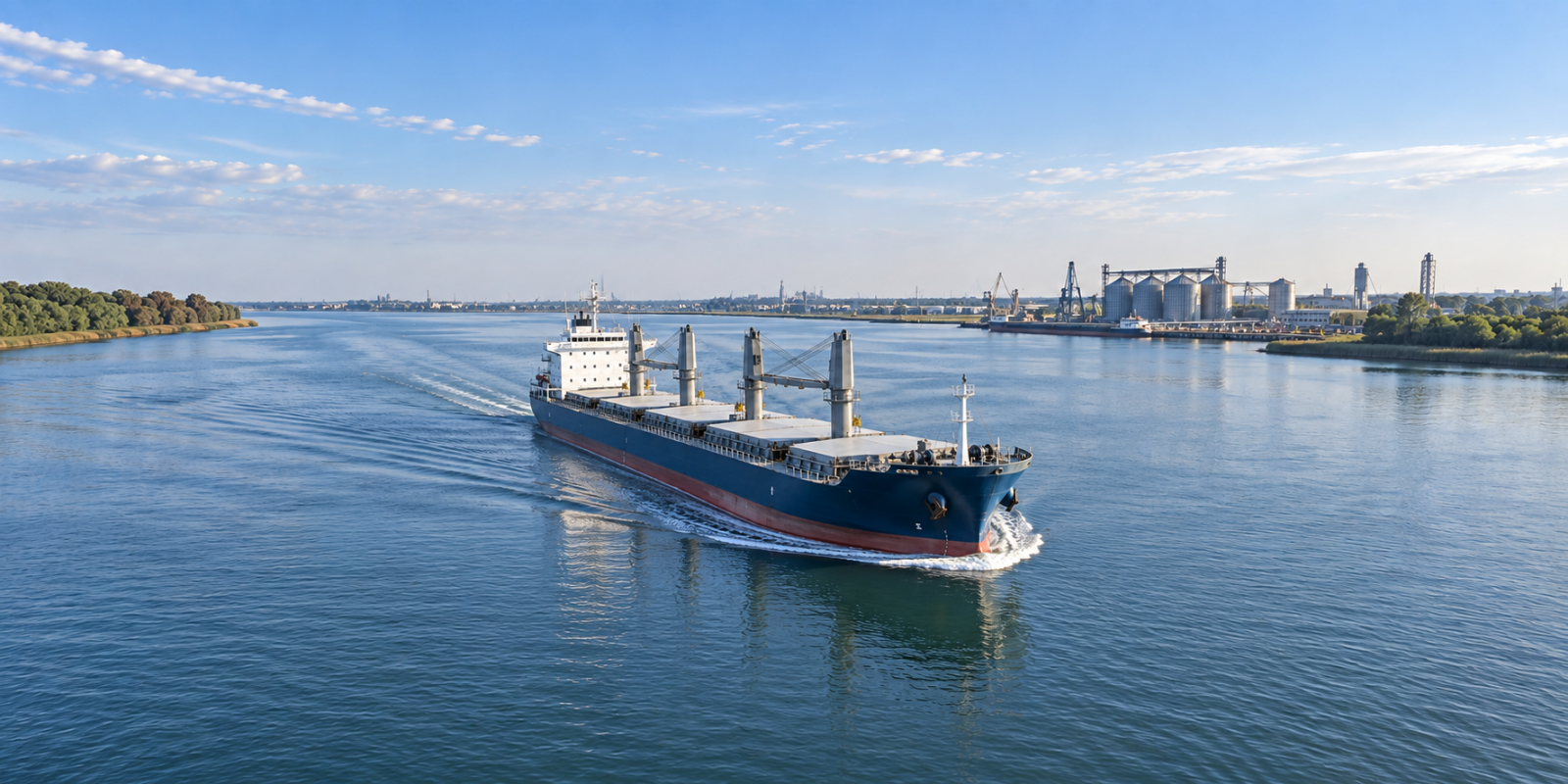
When planning grain shipments via the Danube, clients most often ask about tonnage availability, freight rates, the number of free waiting days at Sulina, permissible draft for passage through the Bystre Mouth, cargo accumulation, and whether any suitable tonnage is opening directly in the Danube.
The FERRY GROUP commercial team has compiled practical answers for shipments via Izmail, Reni and Constanța.
In this article: vessel and contract · rate and tonnage availability · Sulina, Bystre and terminals
1. Why are vessels increasingly sought before the sales contract is fully agreed?
Under the conventional sequence, the exporter first agreed the cargo, quantity, destination and delivery period with the buyer, then sought a vessel against a defined requirement. In some transactions, the process now begins with available tonnage. A vessel appears on the market with a specific opening date, carrying capacity, draft and indicative freight rate. The cargo owner checks the parcel against those parameters, discusses the supply with the buyer and calculates the economics of the transaction. Tonnage suitable for Danube operations is limited by route, port and terminal parameters, so waiting for a fully agreed contract may mean losing a suitable vessel.
2. How long is a shipowner prepared to wait while the charterer agrees the sales contract with the buyer?
This depends on the shipowner’s position and current market conditions. At present, approval windows are often short because demand is high for vessels that can call at Ukrainian Danube ports and whose owners are prepared to trade there. The same vessel may be considered for several cargoes at the same time, and the shipowner will usually favour an option that can be confirmed sooner. The charterer therefore needs to understand in advance how much time is required internally to agree the sales contract with the buyer: the longer the decision takes, the higher the risk of losing available tonnage.
3. Why can a vessel offered today be unavailable tomorrow?
The same vessel may be considered for several cargoes and routes. While the cargo owner is negotiating with the buyer, another charterer may fix the vessel. The next option may have a different opening date, carrying capacity, position or rate. This can affect both the freight cost and the economics of the export contract. A decision should still be properly checked, but the client needs to understand the approval timeline and prepare the required information in advance.
4. What information is needed to check a vessel against a specific cargo?
The initial assessment requires the cargo type and specification, approximate parcel size, loading port or terminal, destination, cargo readiness date, preferred vessel delivery period, loading and discharging rates, known terminal restrictions and any contractual conditions affecting the shipment. Accurate inputs allow unsuitable vessels to be screened out quickly on the basis of draft, carrying capacity, opening date or terminal compatibility.
5. Why can today’s freight rate be different tomorrow?
Freight levels are driven by current demand for tonnage. Demand for vessels suitable for Danube operations is currently high, while availability on specific dates is limited. When demand exceeds effective tonnage supply, rates can move very quickly. An indication received today should therefore not automatically be used to price a transaction several days later; the rate needs to be assessed together with actual tonnage availability for the required period.
6. What determines whether grain can be moved by barge to Constanța?
First and foremost, actual barge availability. At present, demand for barge tonnage exceeds supply. At the same time, according to current market information, a significant number of Serbian barges are expected to be deployed in Danube ports in October, as prevailing freight rates are attractive to their operators. Therefore, even an indicative freight rate does not guarantee that a barge of the required capacity will be available on the required dates. Once tonnage availability is confirmed, the assessment should cover the fleet’s position and opening date, cargo readiness, loading and receiving terminal capabilities, towage and convoy formation, the onward transshipment plan and current navigation conditions. The complete operational chain needs to be assessed together.
7. Which matters more: the rate or the availability of suitable tonnage?
The two cannot be assessed separately. An attractive rate has little practical value if no suitable vessel or barge is available for the specific cargo, route and dates. At the same time, tonnage availability alone does not mean that the proposed terms work for the shipment economics. The practical approach is to confirm realistic fleet options first, then compare the rate, timing and total economics of the movement. This is how FERRY GROUP currently approaches Danube business: first confirm real tonnage, then calculate the terms for the specific cargo.
8. How much waiting time should be allowed for passage through the Sulina Canal?
Romanian agents currently recommend allowing 15–30 days of waiting at Sulina in the contract. The actual period may be shorter or longer depending on the vessel queue, traffic organisation, weather and navigation conditions. If a charterer manages to agree 7–10 days of waiting in the contract, this can be considered a very favourable outcome in the current market. Voyage calculations should take into account both the waiting period itself and the potential costs associated with delay.
9. Which vessels have priority at Sulina?
Under current operating practice, tankers, livestock carriers and container vessels have priority when passing Sulina. These vessel categories pass outside the general queue. For dry cargo vessels, this needs to be considered when estimating the actual waiting time: the number of vessels in the queue alone is not sufficient to predict the passage date accurately.
10. What is the current permissible draft through the Bystre Mouth?
As of 15 September 2026, under Coastal Warning No. 47 published by the State Hydrographic Service of Ukraine, navigation through the Bystre Mouth is permitted for vessels with a draft of less than 5.3 m. This restriction must be considered when selecting a vessel and calculating its potential cargo intake. Navigation restrictions may change and should therefore be reconfirmed before the vessel is agreed and before the voyage begins.
11. Why is the limit of less than 5.3 m not sufficient for planning a call at Izmail?
The restriction for the navigable channel does not automatically mean that a vessel can work at every terminal. The full route and berth depths, the terminal’s permissible draft, vessel length and beam, manoeuvring limitations, stowage plan, under-keel clearance and other navigation requirements must be checked separately. The vessel’s actual cargo intake is determined by the most restrictive limitation across the complete route.
12. How should cargo accumulation be planned before the vessel arrives?
The cargo accumulation schedule is agreed with the terminal or the company arranging storage or accumulation. By the time the vessel is ready to berth for loading, the required cargo volume should be available, or a stable delivery flow should be maintained in line with the agreed loading pace. If cargo is unavailable or arrives more slowly than planned, the vessel may be delayed. This can affect compliance with the cargo-handling rates agreed in the contract and may lead to additional financial costs. Cargo accumulation should therefore be planned together with the terminal, the inland delivery schedule and the expected timing of the vessel’s berthing for loading.
What to confirm before entering the freight market
Before approaching the market, three groups of information should be confirmed: the cargo — type, quantity, readiness and delivery to the terminal; the route — loading port, destination, navigation and terminal restrictions; and the timing and terms — acceptable laycan, cargo-handling rates and the time required for internal approval. This allows suitable tonnage to be checked faster and reduces the risk of the vessel, rate and cargo readiness falling out of alignment.
Check tonnage availability and calculate the route
chartering@ferrygroup.com.ua
+38 (063) 57 38 728
www.ferrygroup.com.ua
Tonnage availability, freight rates, waiting times, permissible draft and navigation conditions are subject to change. All parameters must be checked and confirmed for each individual request.
Official source: State Hydrographic Service of Ukraine, current Coastal Warnings as of 15 September 2026, Coastal Warning No. 47 — navigation through the Bystre Mouth for vessels with a draft of less than 5.3 m. View the official notice.
Tags: